
The owner interface and its patterns
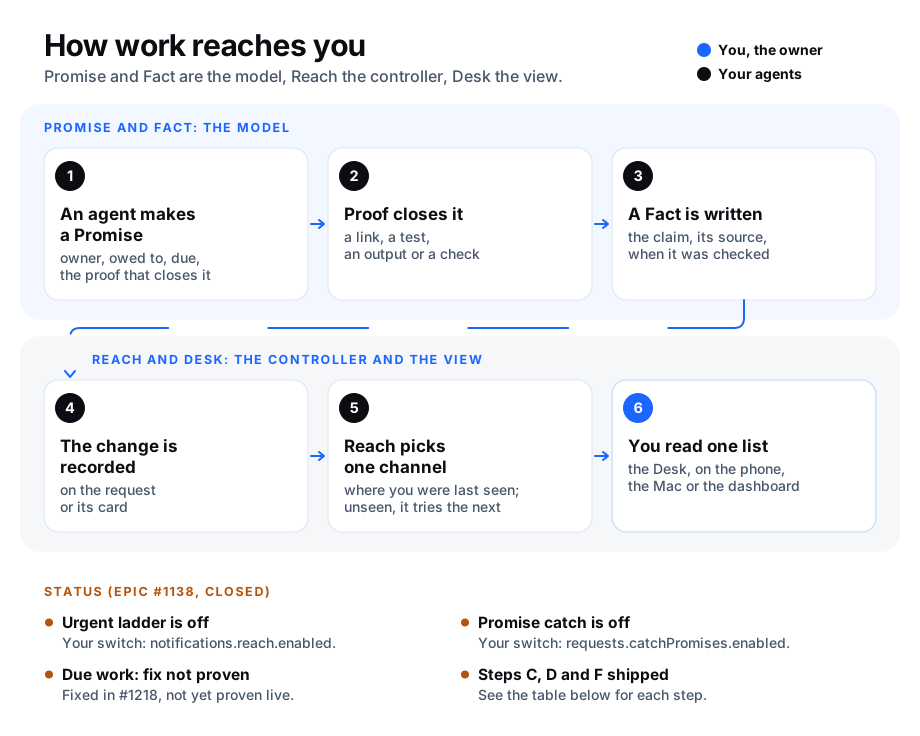
Status: a map, not a feature. Nothing on this page is a setting. It names the parts AgentX uses for work that concerns a person (usually the owner, the person who runs this install), and the recurring shapes that work takes. The plan was #1137; the work to bring the code in line with it was the epic #1138, closed on 2026-10-25. Where the plan landed says what shipped and what is still open.
Classic apps have a well-known split: a model holds the data, a view shows it, a controller decides what happens. Work around a person has its own split. This page names it, so a new feature can say which part it belongs to instead of inventing a fifth place to keep a due date.
The four parts
| Part | Role | What it owns |
|---|---|---|
| Promise | model of work | who owes what to whom, by when, and the proof that closes it |
| Fact | model of truth | what is true, where that came from, when it was checked, and when it goes stale |
| Reach | controller | where the person is, which channel to use, whether the message landed, and what happens if it did not |
| Desk | view | one list of what concerns the person, shown on any surface (phone, dashboard, computer), shaped by settings and not by code |
The parts were meant to talk over the event bus (src/events/bus.ts): one part publishes that something changed, the others listen. The bus still carries only message, task and session events. The Desk is read in one place instead (src/desk/owner-list.ts), and Reach runs on a one-minute check (src/notify/reach-attach.ts), so no "request changed" or "card changed" event was needed.
Patterns
A pattern is a recurring shape of agent work with a name. Each entry below says:
- Problem: what goes wrong without it.
- Shape: the parts it is made of.
- Lives in: where AgentX does it today. A path is checked by a test, so it cannot go stale silently. A pattern that is not built yet names the step of #1137 that builds it.
- Do it well: the practice to follow when you touch it.
Promise
- Problem: "done" is said without proof, and nobody knows who is waiting.
- Shape: an owner, who it is owed to, a due time, and the proof that closes it.
- Lives in:
src/requests/store.ts(thepromise,owed_to,due_atandclose_whencolumns),src/requests/promise.ts(the one way to open, raise and close one; closing with a proof writes a fact),src/requests/tool.ts(thepromiseaction agents call),src/requests/catch.ts(reads "I'll do X" from a reply, when switched on). - Do it well: record a promise when you make it, not when you finish. Give it a
closeWhencheck wherever one exists, so the daemon closes it and not your memory.
Fact
- Problem: an old truth is repeated with confidence.
- Shape: a claim, its source, when it was checked and by whom, and a volatility class that sets how fast it goes stale.
- Lives in:
src/wiki/facts/ledger.ts. - Do it well: past its time limit, check a fact at its source before stating it, and record the check. If you cannot check it, say it is unverified.
Home
- Problem: the same thing is tracked in three places, and the three disagree.
- Shape: one record per thing. Everything else points at that record.
- Lives in:
src/requests/store.tsandsrc/approvals/cards.ts. Watchers (src/watchers/store.ts) and plan steps (src/requests/plan-store.ts) keep their own stores, but their escalation and their done go through the one promise path insrc/requests/promise.ts. - Do it well: before adding a table with a due date or a status, check whether a request or a card already is the home.
Listener
- Problem: what a party says on a channel is heard as pings and never recorded.
- Shape: a channel and the parties to watch on it, turned into records.
- Lives in:
src/channels/inbound/pipeline.ts(every inbound message passes its stages),src/requests/tracker.ts(turns a person's turn into a request). - Do it well: write what was heard to a record (a request, a card, a fact) before alerting anyone, so the alert can point at it.
Party
- Problem: clients are handled as names inside messages.
- Shape: a person with a role (
owner,member,client,guest). - Lives in:
src/people/people.ts. - Do it well: refer to people by their person record, not by a name in free text.
Reach
- Problem: news is shouted on every channel at once, or sent to a channel that stopped working.
- Shape: where the person was last seen, then one channel, then a wait, then the next channel.
- Lives in:
src/notify/index.ts(sends),src/notify/reach.ts(presence, the sent → seen → answered marks, the next-channel ladder, channels that are down),src/notify/reach-attach.ts(runs it in the daemon). - Do it well: send to one place. Urgent items may move to the next channel when unseen; everything else waits for the digest.
Told once
- Problem: the same news arrives on four surfaces.
- Shape: one record of what the person was told, keyed by item, across all channels.
- Lives in:
src/notify/told.ts(ToldLedger,OwnerGate), used by the daemon'stellOwner()insrc/daemon/index.ts. - Do it well: tell the owner through the notify path (
agentx notify, or the daemon's own notices), never by calling a channel directly, so a repeat is caught.
Hold
- Problem: someone who is focused or on a call gets interrupted.
- Shape: non-urgent messages wait until the hold ends.
- Lives in:
src/notify/focus.ts,src/notify/hold.ts. - Do it well: mark only true emergencies urgent. A hold that everyone bypasses is no hold.
Digest
- Problem: reminders and nags arrive one by one as pushes.
- Shape: low-value notices are folded into one message at a set hour.
- Lives in:
src/notify/told.ts(thedigestoutcome),src/approvals/sweep.ts(sends it). - Do it well: a nag ("not finished", "disk low") goes to the digest. Only news the person must act on now is pushed.
Approval with expiry
- Problem: a yes from last week is used for today's action.
- Shape: a yes scoped to one action, with an expiry and a default that applies if nobody answers.
- Lives in:
src/approvals/cards.ts(expires,if_silent),src/approvals/sweep.ts(applies the default). - Do it well: one question per card, with a default you would accept if the person says nothing.
Verdict
- Problem: a judgment is given as free text that nobody can audit.
- Shape: a typed answer with a probability, recorded so it can be checked later.
- Lives in:
src/decisions/seat.ts,src/decisions/store.ts. - Do it well: when the same judgment is made many times with known options, ask a decision seat instead of reasoning in a reply.
Chaser
- Problem: things go quiet and nobody notices.
- Shape: after a stall time, a nudge; then an escalation; a fixed number of times, then stop.
- Lives in:
src/requests/sweep.ts,src/requests/plan-sweep.ts,src/watchers/due.ts. - Do it well: every chaser has a limit. After the last nudge it tells the owner once and stops.
Evidence watcher
- Problem: saying "done" closes nothing, or closes things that are not done.
- Shape: an item closes only when a check passes: a page, an issue state, a commit on a branch, a reply, a test.
- Lives in:
src/requests/checkers/index.ts,src/watchers/evidence.ts. - Do it well: prefer a check the daemon can run over a link a person has to open.
Handoff
- Problem: what a session knew is lost when it ends.
- Shape: a short memo: the objective, the state, the next action, and what was checked versus assumed.
- Lives in:
src/agents/rotation-memo.ts,src/agents/rotation-memo-store.ts. - Do it well: write the memo before the session ends, and mark which statements you checked.
Delegation result
- Problem: an answer goes to the wrong person, or to nobody.
- Shape: the answer returns to the agent that asked, on the thread where the person asked.
- Lives in:
src/a2a/delegation.ts. - Do it well: delegate with a callback and end your turn. Do not hold the person's turn open while another agent works.
Plan gate
- Problem: big work starts without a plan.
- Shape: an estimate. Work of a set kind, or over a set number of minutes, needs a plan with steps and a proof per step.
- Lives in:
src/requests/daemon-api.ts(refuses the accept),src/requests/plan-store.ts(keeps the steps). - Do it well: give each step a proof someone else can check, not "done".
Where the plan landed
The epic #1138 had seven steps. Each one had a proof of done, checked on a live node before the epic was closed on 2026-10-25.
| Step | What it does | Lives in | Proof |
|---|---|---|---|
| A. Settle on hand-back | a request closes when the work it handed out comes back done | src/requests/store.ts | Failed at the epic's close: requests with a due time were skipped (#1214). Fixed in #1218, not yet proven live. |
| P. This page | names the parts and patterns | docs/architecture/patterns.md | Met. |
| B. Reach | seen and answered marks, an urgent ladder, channels that are down in /health | src/notify/reach.ts | Partly met. Marks and /health work. The ladder is off by default, so escalation was not seen live. |
| C. One Desk | one list and one count of what waits on the owner, routed by three settings | src/desk/owner-list.ts, src/desk/route.ts | Met. |
| D. Promise → Fact | one promise path; closing with a proof writes a fact | src/requests/promise.ts | Met, with tests. |
| E. Catch "I'll do X" | reads a firm promise from a reply | src/requests/catch.ts | Precision met (1.00 on a held-out set, see bench/README.md). Off by default, so not measured live. |
| F. Status follows the work | tells when an issue's status label is behind the work | src/requests/status-board.ts | Met. |
Two switches are the owner's choice, not open work:
notifications.reach.enabledturns on the urgent ladder. See Get notified › Did it land.requests.catchPromises.enabledturns on the promise catch. It spends one short model call on most of your turns. See Promises caught in a reply.
Adding or changing a pattern
- Add a
###entry under Patterns, with the four lines Problem, Shape, Lives in and Do it well. - In Lives in, put each code path in backticks, starting with
src/. If it is not built yet, name the issue step that builds it. - Run the check below.
Check it worked
In a terminal, from the repo root:
- Run
pnpm vitest run test/docs-patterns.test.ts. - It passes when every pattern has its four lines and every path in backticks exists.
If something is wrong
- A path is reported missing: the code moved or was renamed. Update the path on this page in the same pull request that moved it.
- A pattern is reported incomplete: one of the four lines is missing or empty. Add it.